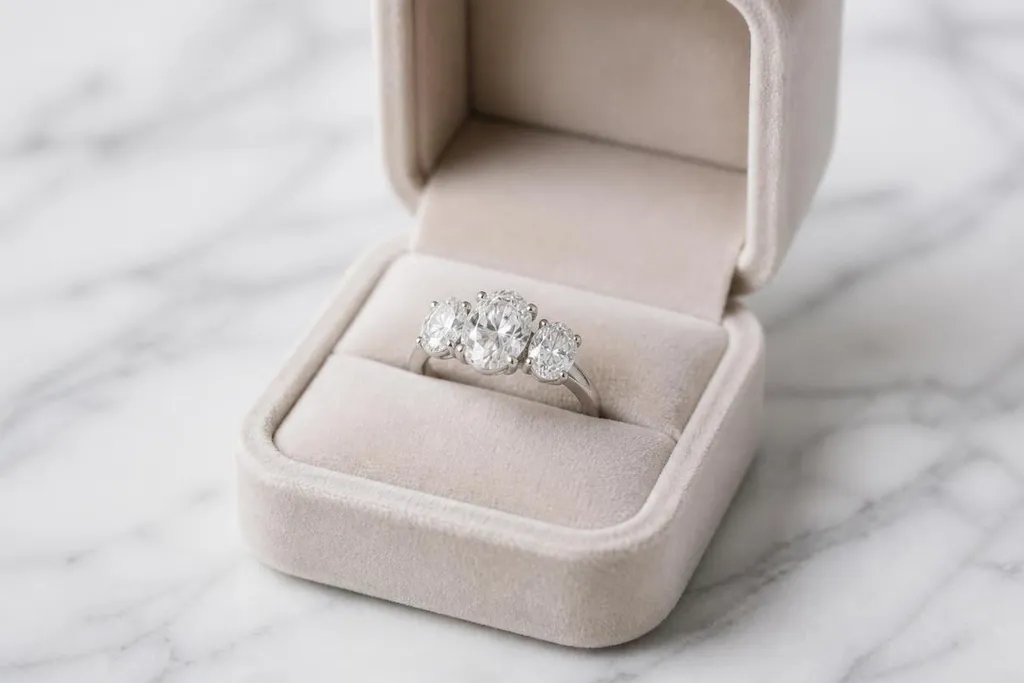
A trilogy engagement ring already offers more visual storytelling than a conventional solitaire, but mixing diamond shapes takes the idea further. Pairing an oval lab-grown centre diamond with pear-cut side stones creates a composition that feels balanced without being repetitive. The oval establishes a graceful central line, while the tapered pears draw the eye outward towards the band. In 18k yellow gold, those bright diamond shapes gain a warm frame that makes their individual outlines easier to appreciate.
For someone interested in this combination, the option to order the yellow gold Blossom ring from Lily Arkwright illustrates how oval and pear lab diamonds can form a cohesive trilogy rather than appearing like three separate stones. The effectiveness of the design depends on proportion: each side diamond should support the oval centre while preserving its position as the natural focal point.
Why Oval and Pear Shapes Work Together
Mixed-shape trilogy rings are most convincing when the stones share enough visual characteristics to feel related while still performing different roles.
Oval and pear cuts achieve this naturally. Both feature curved outlines and elongated proportions, so the transition between them feels fluid. The pear shape then introduces a tapered point, creating direction and helping the arrangement narrow towards the shoulders.
Orientation matters. With the pointed ends of the pear diamonds facing outward, the side stones act almost like a bridge between the broader centre diamond and the band. This can create a more graceful transition than three similarly sized stones arranged in a straight sequence.
The centre oval remains important because its symmetrical outline provides stability. Without that strong focal point, an arrangement containing multiple tapered stones could feel overly busy.
This combination therefore offers detail without sacrificing visual order.
Getting the Proportions Right
A trilogy ring is not simply about choosing three attractive diamonds individually. They need to make sense as a group.
The centre oval should normally carry greater visual weight than the pear side stones. If the pears are too large, the distinction between centre and sides becomes less obvious. If they are excessively small, they can look disconnected rather than integral to the composition.
The oval's own proportions also influence the result. A broader centre stone creates a fuller arrangement, while a more elongated oval gives the trilogy a slender, lengthened appearance.
Carat weight needs similar context. Someone may prefer a 2-carat centre diamond because it establishes a stronger focal point and provides greater contrast with the pear sides. Another wearer might deliberately choose a smaller centre stone to create a more integrated three-diamond composition with less emphasis on scale.
What matters is the relationship between the stones rather than any one carat figure.
How Yellow Gold Changes the Character
An 18k yellow gold setting introduces warmth to what is otherwise a highly diamond-focused design.
With three bright stones positioned closely together, a white metal can visually merge into the diamonds and create an almost continuous field of brightness. Yellow gold produces clearer separation. Small glimpses of warm metal around the settings and across the band help define each diamond's silhouette.
This contrast can be particularly attractive with mixed cuts because shape is central to the design. The eye can distinguish the rounded oval centre from the tapered pear diamonds more readily.
Yellow gold also gives the trilogy a traditional undertone. Three-stone engagement rings have enduring associations with symbolism and milestone jewellery, while mixed lab-diamond shapes introduce a more contemporary interpretation.
The result sits comfortably between classic and modern rather than belonging exclusively to either style.
Styling a Mixed-Shape Trilogy for Everyday Wear
Because the trilogy already provides significant width and detail across the finger, the wedding band does not necessarily need to be elaborate.
A plain 18k yellow gold band can create a useful visual pause beneath the diamonds. For someone who prefers greater brilliance, a fine diamond-set band can complement the trilogy without competing with its distinctive oval-and-pear arrangement.
The profile of the centre and side settings should be considered before selecting a wedding ring. Some trilogy designs accommodate a straight band closely, while others may pair more naturally with a shaped or contoured design.
Care is also important because three principal stones mean several setting points need to remain secure. Periodic professional inspections can help monitor claws, while gentle cleaning prevents residue from accumulating around the closely positioned diamonds and reducing their sparkle.
Final Thought
An oval-and-pear trilogy succeeds because the shapes complement rather than imitate one another. The oval lab diamond provides symmetry and a clear centre, while pear-cut side stones introduce taper, movement and additional brilliance.
Framed in 18k yellow gold, the mixed shapes become even more distinct, producing a ring with warmth as well as visual complexity. For someone who wants more detail than a solitaire but still values balanced proportions, this combination offers a sophisticated way to make the traditional three-stone engagement ring feel individual and contemporary.